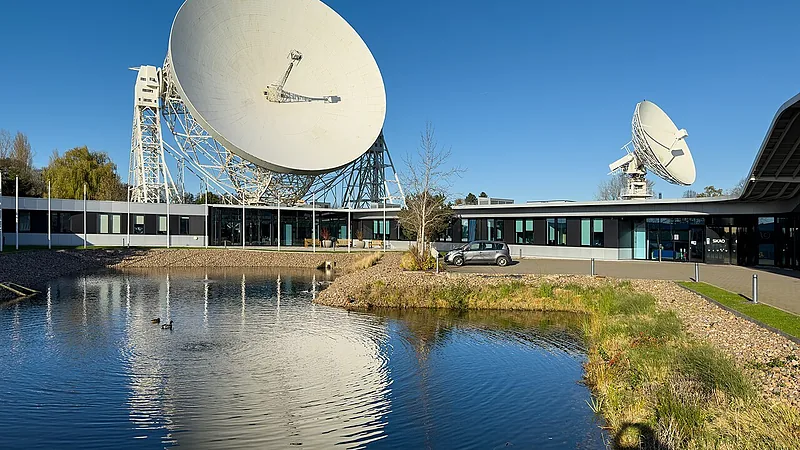
Jodrell Bank Observatory, home to the Lovell telescope in Cheshire, could close after losing its funding, BBC News reports.
The observatory has supported UK radio astronomy for nearly 70 years and has played a major role in research into distant galaxies, as well as training astronomers. According to the BBC, scientific observations at the site are expected to end on 1 April 2028 unless replacement funding is secured.
UK Research and Innovation said it had to direct funding towards projects offering “the greatest long-term impact”. The agency, which has an annual budget of just under £10bn, has cut the observatory’s £2.8m annual budget amid rising planned costs for physics research and laboratory operations.
The decision forms part of wider reductions affecting astronomy, nuclear and particle physics research over the next four years. The BBC said the UK will also end its participation in research at the James Clark Maxwell Telescope in Hawaii, while funding has been cut for UK involvement in two instruments on the Extremely Large Telescope in Chile. Some upgrades linked to Large Hadron Collider experiments will also not be funded by UKRI.
Prof Brian Cox, of the University of Manchester, which hosts Jodrell Bank Observatory, described the cuts as “hasty and ill-considered”. Jonathan Reynolds, the Secretary of State in the expanded business department now responsible for science, told BBC News he was committed to working with UKRI to maintain the UK’s research capabilities while investing in future facilities.
The Jodrell Bank site was founded in 1945 and became a centre for radio astronomy. It was also used during the Cold War to monitor Soviet missiles, and was awarded Unesco World Heritage status in 2019.
Twenty-eight jobs are at risk at the site, while the BBC reports that almost 3,000 scientists who use the observatory in their work would also be affected. Prof Simon Garrington, associate director of Jodrell Bank Observatory, said staff were “devastated” and that the decision would be challenged. He said the leadership team would seek alternative funding if those efforts failed.
The Lovell telescope is the main instrument in the e-Merlin network, which links seven telescopes across central England. The network is used to study planet and star formation, galaxy evolution, supermassive black holes, dark matter and dark energy.
Prof Michael Kramer, executive director of the Max Planck Institute for Radio Astronomy in Bonn and a scientist at the University of Manchester, told the BBC he viewed the decision as scientifically, technologically and economically short-sighted. Prof Catherine Heymans, Scotland’s Astronomer Royal, described the move as “a real act of national self-harm”.
The BBC reported warnings from astronomers that the loss of Jodrell Bank and the e-Merlin network would damage the UK’s radio astronomy capability as other countries invest in the field, including through the Square Kilometre Array project in South Africa and Australia.